Skip to content
Kitchens in Art: Paintings and Photos to Know
I have a thing for kitchens. Show me a house and I’ll glance at the living room, nod at the bedroom, and then head straight for the stove and the sink. It might sound cliché to say the kitchen is the heart of a house, but that’s where the good stuff happens—coffee, chaos, late-night leftovers, actual life.

I’m also nosy in a very specific way: I always want to know what you’re eating. Who are you? What’s in your fridge? What pan never leaves your stove? What do you reach for when you’re tired and hungry? That curiosity is probably why I love kitchens in art so much—they’re like tiny portals behind the curtain, letting us stand in the middle of someone else’s mess, rituals, and meals without ever having to knock on their door. (Check out this brilliant image by photographer Bill Owens)

How Kitchens in Art Evolved from the 1600s to Today
From the 17th century on, kitchens in painting say a lot on class as well as daily routine. In Spain, Velázquez crowds his bodegones with servants, cheap clay pots, and simple food, while the owners stay offstage. In the Netherlands, Vermeer and Pieter de Hooch fill tiled interiors with maids, children, and copper, quietly mapping who works, who teaches, and who moves freely through the house. The surfaces are calm, but the hierarchy is clear.

By the 18th and 19th centuries, Chardin gives kitchen maids a steady, almost dignified presence, yet they still sit firmly in the servant tier. Later, Impressionist and post-Impressionist painters offer quick, steamy glimpses of cooks and waitstaff in back rooms, close to the heat and far from the dining table.
The Lineup: Kitchens I Keep Coming Back To
Now that the broad timeline is out of the way, we can walk into specific rooms. The works in this lineup are the ones I keep mentally bookmarking—paintings and photographs where you can almost hear the pan sizzling or the freezer door slam.
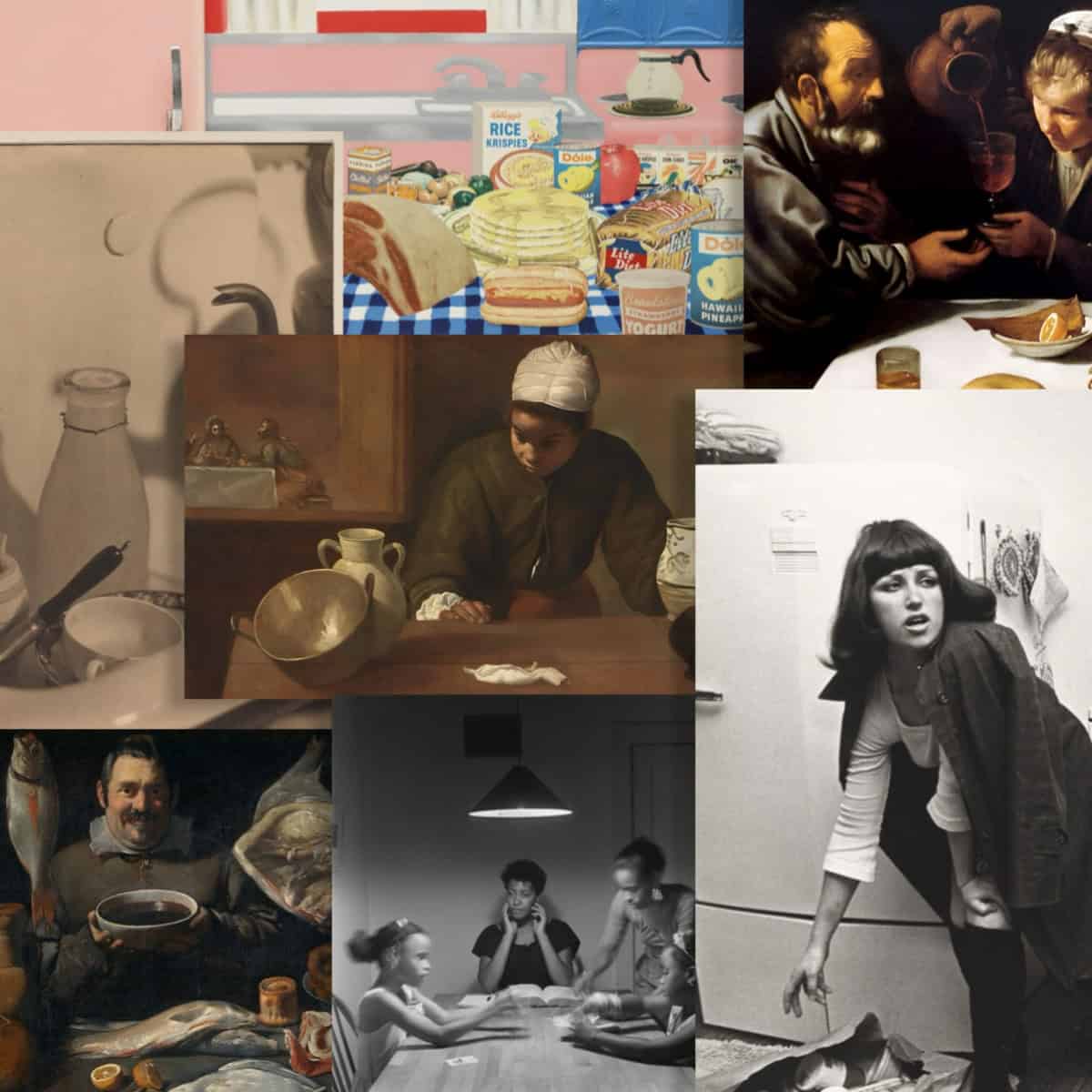
From Velázquez’s eggy bodegones to Cindy Sherman’s domestic chaos, these twelve kitchens trace a path through four centuries of cooking, cleaning, caregiving, and drama. Here they are, in chronological order.
Diego Velázquez, Old Woman Frying Eggs (1618)
Medium and where: Oil on canvas; Scottish National Gallery (National Galleries of Scotland), Edinburgh.
Velázquez was around nineteen when he painted this, and motifs like the mortar, pestle, and eggs show up again in his other early kitchen scenes, so you can literally spot the same cookware doing a second shift across his bodegones.

Diego Velázquez, Christ in the House of Martha and Mary (c. 1618–20)
Medium and where: Oil on canvas; National Gallery, London.
One fun twist: the biblical scene in the background may be read as either a “real” room seen through an opening or as a painting or vision on the wall, which fits the idea that the kitchen is where the servant stands, while the miracle happens at a distance she can’t quite reach.

Johannes Vermeer, The Milkmaid (c. 1658–61)
Medium and where: Oil on canvas; Rijksmuseum, Amsterdam.
Art historians love to point out the tiny Cupid tile and the footwarmer on the floor: in 17th-century visual code, those could hint at desire quietly simmering under all that wholesome bread and milk, even though Vermeer keeps her completely absorbed in the task at hand.

Pieter de Hooch, Interior of a Kitchen with a Woman, a Child and a Maid (c. 1656–60)
Medium and where: Oil on canvas; private collection.
De Hooch was obsessed with “views through” rooms, and this kitchen is part of that obsession: the tiled floor and open doorway pull your eye from the pots and baskets in the foreground straight toward another sunlit space, turning a working kitchen into a little architectural maze.

Jean-Baptiste-Siméon Chardin, The Kitchen Maid (1738)
Medium and where: Oil on canvas; National Gallery of Art, Washington, D.C.
Chardin signed and dated this one directly on the wall above the chopping block, and he painted at least four versions of the composition, which tells you how popular the image of this paused, not-quite-busy maid was with 18th-century collectors.

Margaret Watkins, The Kitchen Sink (1919)
Medium and where: Palladium (platinum/palladium) print; Cleveland Museum of Art, Cleveland.
When Watkins first exhibited this sink full of dirty dishes, it was considered a slightly scandalous subject; almost a century later, the same photograph ended up on a Canadian postage stamp in 2013, which is a wild promotion from “unseemly motif” to national icon.

Tom Wesselmann, Still Life #30 (1963)
Medium and where: Oil, enamel and acrylic on board with collage (printed ads, plastic flowers, refrigerator door, plastic 7-Up bottles, glazed color reproduction, stamped metal); Museum of Modern Art, New York.
The pink fridge door and the 7-Up bottles aren’t painted illusions — they’re actual objects bolted into the piece, so the “kitchen” literally sticks out from the wall like a shallow set, half painting and half appliance showroom.

William Eggleston, Untitled (Freezer) (c. 1971–73, printed 1980)
Medium and where: Dye transfer print; High Museum of Art, Atlanta.
Eggleston used the same high-end dye-transfer process that was usually reserved for glossy advertising, which is why the frost, meat packets, and plastic look more saturated and jewel-like than real life — it’s basically a supermarket freezer treated with the color drama of a religious painting.

Martha Rosler, Semiotics of the Kitchen (1975)
Medium and where: Single-channel video, black-and-white, sound; examples in the collections of the Metropolitan Museum of Art, the Smithsonian American Art Museum, and others.
Rosler goes through kitchen utensils alphabetically, from apron to tenderizer, performing each one with increasingly aggressive gestures — she once described herself here as an “anti–Julia Child,” hijacking the TV cooking-show format to spell out frustration instead of recipes.
Cindy Sherman, Untitled Film Still #84 (1978)
Medium and where: Gelatin silver print; Museum of Modern Art, New York (and other collections).
The entire Untitled Film Stills series is printed at roughly 8 x 10 inches, so this “movie still” kitchen scene is actually small and intimate in person, more like a snapshot than a film poster — which makes the illusion of a whole invented B-movie character that much weirder.

Carrie Mae Weems, Kitchen Table Series (1990, printed 2003)
Medium and where: Portfolio of 20 platinum/palladium prints and 14 screenprints; National Gallery of Art, Washington, D.C., and other institutions.
Weems stages the scenes in her own kitchen and uses herself as the main figure, but she’s said the woman is a character, not a self-portrait — the table and overhead lamp stay constant while the roles around them shift, which turns this one kitchen into a whole lifetime of relationships.


Why These Kitchens Stay With You
Looking at all these kitchens together, it starts to feel like artists have been just as nosy as the rest of us. Velázquez wants to show you the exact curve of a copper pan and the way egg whites catch the light. Vermeer lingers on bread crusts and a single stream of milk. Watkins points her camera straight into a dirty sink. Weems centers a table that has seen every version of a relationship.
They’re all asking some version of the same questions you ask when you walk into a real kitchen: Who lives here? What are they eating? How tired are they? Who is doing the work, and who gets to sit?
Once you see these rooms this way, it’s hard to unsee it. A freezer full of boxed meals starts to feel like an Eggleston photograph. A lone lamp over a breakfast table starts to echo Carrie Mae Weems.
The next time you step into someone’s kitchen—your own included—you might notice the chipped mug that never leaves the counter, the one reliable pan, the way light hits the sink at 4 p.m. Artists have been studying those same tiny details for centuries. The only difference is they turned their curiosity into paintings and photographs, and you get to stand there, nosy and delighted, peeking over their shoulder.