
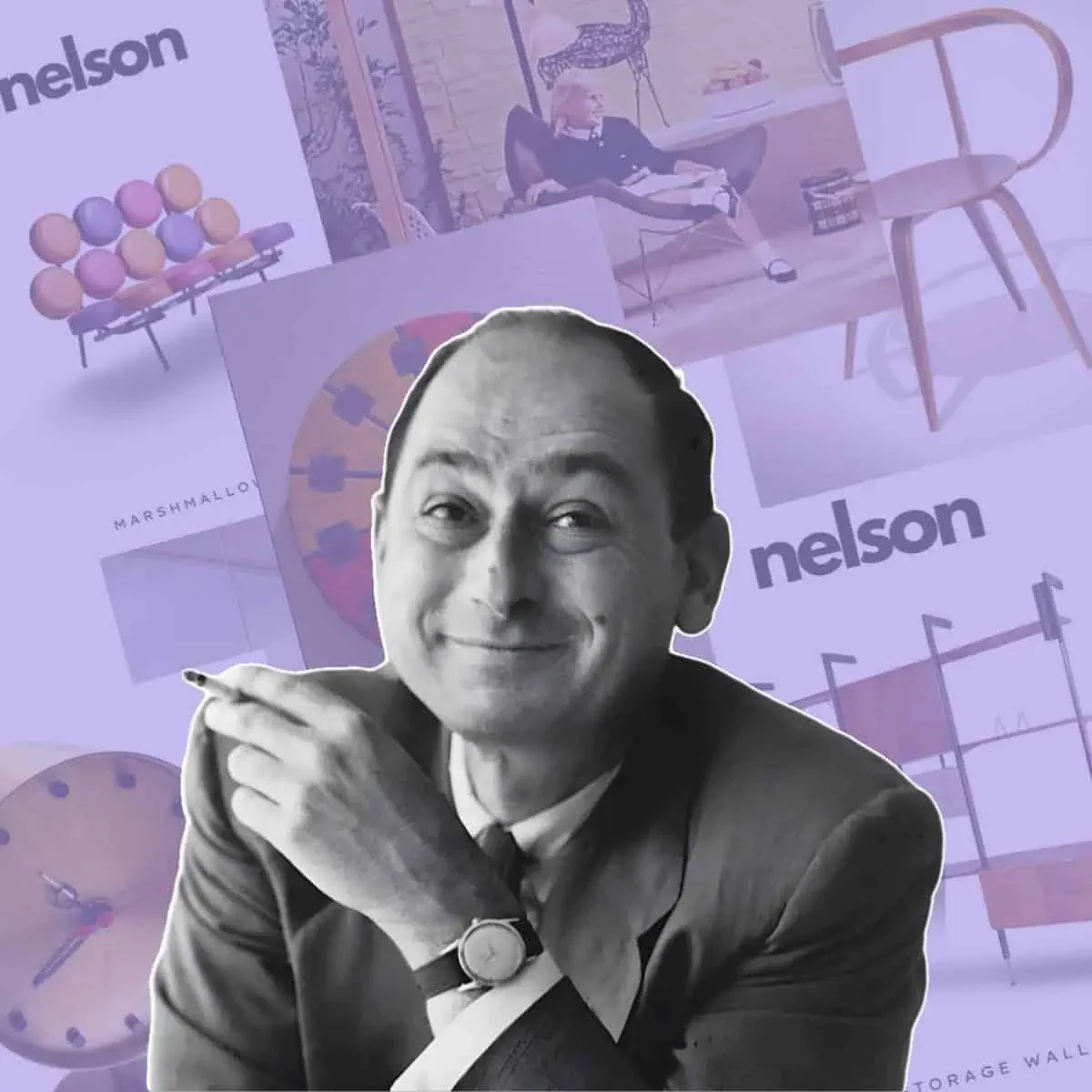
George Nelson Furniture Design and Clocks
A client once asked me to source a clock. Easy enough—until I made the mistake of sending them a few George Nelson options. Too “weird,” they said. “A little too designy.” They went with something safe and forgettable, probably still ticking away above a beige sectional. But I couldn’t stop thinking about one of the desk clocks I’d flagged. So I bought it for myself. It’s been on my bookshelf ever since—tucked between a stack of out-of-print monographs and a ceramic ashtray I don’t use. It’s perfect.

Turns out, that little desk clock opened a door. George Nelson wasn’t arranging shapes for fun—he was sketching out a whole new way to live. His clocks were playful, yes, but behind the charm was structure, intent, and a kind of design clarity that still cuts through. From bubble lamps to storage walls to sofas that looked like candy, Nelson gave form to a new kind of modern.
Here’s where it started.
George Nelson: Early Life, Yale Years, and Design Influences
George Nelson was born in Hartford, Connecticut in 1908.
He studied architecture at Yale and graduated in 1928, then stayed on to earn a second degree in 1931.
In 1932, he won the prestigious Prix de Rome and spent two years at the American Academy in Rome.
While in Europe, he interviewed architects like Le Corbusier and Mies van der Rohe—those conversations were published back in the U.S. and helped introduce the European avant-garde to American readers.
When he returned, Nelson joined the editorial staff at Architectural Forum.
He wasn’t there to describe buildings. He was pushing design thinking—ideas, not decoration.
In a 1942 piece on postwar planning, he proposed a pedestrian-only commercial district. That idea showed up later in cities all over the country.
In 1945, a piece in Life magazine featured his “Storagewall” concept.
D.J. De Pree, the founder of Herman Miller, saw it and reached out.
By the following year, Nelson had been named Director of Design.
He stayed with the company for the next 25 years, building the foundation of what American modernism would look like.
George Nelson died in New York City in 1986. He was 77.
George Nelson’s Design Philosophy: Clarity, Intent, and Human-Centered Thinking
George Nelson didn’t believe in design for design’s sake. He saw it as a response—a direct, intentional reaction to how people live, move, work, and think. “Design is a response to social change,” he once wrote, and he meant it. He wasn’t chasing style. He was solving problems.

He believed that good design required a conscious break with anything antihuman—anything that made life more rigid, less joyful, or less clear. He called for a broader view: one where designers stopped specializing and started connecting the dots between disciplines, spaces, people, and objects.

In practice, that meant rethinking everything from clocks to office systems. His work wasn’t driven by ego. It was driven by observation. Nelson believed that the best ideas came when you stopped trying to invent—and started paying attention.
George Nelson Furniture and Lighting Designs That Shaped Mid-Century Style
Each of these pieces helped shape the language of mid-century design. They weren’t simply stylish—they came with stories, quirks, and studio legends that still surface decades later.
Ball Clock (1949)
Officially credited to Nelson, but designed by Irving Harper—after a late-night, wine-soaked brainstorming session in the studio with Bucky Fuller and Isamu Noguchi. No one took notes. Harper remembered the sketch. Nelson took the credit.

Marshmallow Sofa (1956)
Originally a failed experiment in self-skinning foam. The manufacturer offered Nelson 50 discs as a sample, and the studio built a prototype around them. It was meant to be cheap. It wasn’t. Nelson kept it anyway—he liked that it looked like candy and nothing else in the Herman Miller catalog.

Coconut Chair (1955)
A one-liner turned product: “It’s like a coconut cut into eight sections.” That’s what Nelson said, and that’s what stuck. The chair was shaped in fiberglass, which made it cheap to mold and easy to pitch as futuristic. It also looked good in magazine shoots—always a bonus.

Bubble Lamps (1947)
Nelson saw a Swedish silk-covered pendant lamp he loved—but couldn’t afford. So he found a military supplier that made self-webbing plastic spray used on ships and airplanes, and sprayed it over a steel frame. It worked. Howard Miller picked it up, and the rest is lighting history

Swag Leg Desk (1958)
The legs were formed using a metalworking technique called swaging—forcing tubes into shape under pressure. Nelson liked the word as much as the look. The desk was meant to solve a design challenge: how to make furniture that looked light but didn’t wobble.

Platform Bench (1946)
Nelson designed this for his office lobby—practical, simple, with visible slats and minimal joinery. But he didn’t call it a bench. In the early catalogs, it was listed as a low table, meant for display. Sitting on it came later.

Storagewall (1945)
It showed up in Life magazine as part of a spread on postwar home ideas. Modular shelving that covered an entire wall—radical at the time. Nelson called it “built-in flexibility.” The press called it brilliant. D.J. De Pree read the article and immediately flew to New York. That meeting led to Nelson joining Herman Miller.

Real-Life Interiors with George Nelson Furniture and Lighting
I’ve searched high and low—across blogs, design archives, and socials—to find the best examples of Nelson’s work out in the wild. These are real spaces, not staged showrooms. And they’re proof that these designs still carry weight.


George Nelson’s Career Timeline: Key Dates and Design Milestones
- 1908 – Born in Hartford, Connecticut
- 1928 – Earned undergraduate degree in architecture from Yale
- 1931 – Completed second degree at Yale School of Fine Arts
- 1932–34 – Studied at the American Academy in Rome after winning the Prix de Rome
- 1935 – Joined Architectural Forum as editor and writer
- 1945 – Published the Storagewall concept in Life magazine
- 1946 – Hired as Director of Design at Herman Miller
- 1947 – Designed the first Bubble Lamp using military spray technology
- 1949 – The Ball Clock was produced (designed by Irving Harper in his studio)
- 1955 – Released the Coconut Chair
- 1956 – Launched the Marshmallow Sofa
- 1958 – Introduced the Swag Leg Desk
- 1960s–70s – Oversaw designs for office systems, exhibitions, and corporate branding under George Nelson & Associates
- 1972 – Ended formal relationship with Herman Miller
- 1986 – Died in New York City at the age of 77
Why George Nelson Furniture Still Belongs in Modern Interiors
That little clock I bought all those years ago? It still sits on my shelf, ticking away like it has nothing to prove. It’s small, sure—but once you know who designed it, it starts to feel like a statement. George Nelson didn’t set out to build monuments. He created objects that slipped into everyday life, made it better, and kept going. Whether it’s a bubble lamp casting soft light in a hallway or a platform bench holding a stack of art books, his designs still do what they were meant to do—without fuss, without flash, and somehow, without aging a day.
Sources & Further Reading
Dwell: George Nelson Biography
Metropolis Magazine – Nelson’s Design Philosophy
MoMA Collection: George Nelson
Design Within Reach: George Nelson Products