The Elegant And Functional Furniture Design Of Jean Prouvé
Alright, let’s talk about Jean Prouvé, because if there’s one designer who completely nailed that mix of practicality and style, it’s him. Prouvé’s work goes beyond just making beautiful pieces; it’s about creating furniture that stands the test of time. He’s like that friend who’s effortlessly cool but also knows how to build things with their hands—except, you know, on a legendary scale. His modernist designs, from his iconic chairs to his revolutionary prefabricated architecture, still feel fresh and relevant today.

We’re going to dig into Prouvé’s story—how he started, his game-changing milestones, and the designs that continue to pop up in modern retro interiors. So, whether you’re a design geek or just looking for a bit of inspiration to update your space, you’re in for a treat.
Biography: Jean Prouvé’s Early Life and Career
Let’s rewind to the beginning. Born in Paris in 1901, Jean Prouvé grew up surrounded by creativity. His father, Victor Prouvé, was a celebrated artist and a leader in the Art Nouveau movement and his mother, Marie Duhamel, was a pianist, so it’s safe to say that artistry ran in the family. But Jean didn’t just stick to traditional art—he had this incredible ability to take the beauty of craftsmanship and pair it with the practicality of industrial design. Honestly, it’s that blend of creativity and problem-solving that makes his work so fascinating to me.

What I love about Prouvé is that he didn’t just dream about making things; he rolled up his sleeves and got to work. He trained as a blacksmith, spending hours in metal workshops, and by the 1920s, he was already pushing boundaries with materials like steel and aluminum. His approach wasn’t about following trends—it was about creating designs that worked beautifully and lasted a lifetime.
In 1924, he opened his first workshop in Nancy, France, and that’s when things really started to take off. Prouvé had this incredible knack for combining old-school craftsmanship with modern manufacturing, which is why his work feels both timeless and forward-thinking. Pieces like the Standard Chair weren’t just furniture—they were solutions, thoughtfully engineered to be strong, functional, and elegant.

By the 1930s, his reputation was growing. His work in prefabricated architecture showed his dedication to making design accessible and efficient, whether it was for housing or public spaces. And during World War II, he stepped up with practical designs for emergency shelters and portable buildings—proving that good design can make a real difference, even in challenging times.
After the war, Prouve moved his Ateliers Jean Prouvé to Maxeville (near Nancy) and into a bonafide factory, which became the heart of his innovative work in prefab structures and modular furniture. This is where some of my favorite pieces, like the Compas Table and Antony Chair, came to life. There’s something about his ability to make furniture feel both functional and artful that keeps his designs so relevant, even today.

And here’s the kicker: by the 1950s and 60s, Prouvé was rubbing elbows with some of the biggest names in architecture, lending his expertise to projects across Europe. One of his most significant roles was chairing the jury for the design of the Centre Pompidou in Paris. Can you imagine being the person who helped greenlight such an iconic building?
For me, Jean Prouvé’s story is inspiring because it’s not just about creating beautiful things—it’s about solving problems in a way that feels effortless and intentional. Whether it’s his thoughtful use of materials or the way his designs just fit into any space, there’s a level of care and intelligence in his work that I can’t help but admire.
Key Designs: 5 Iconic Jean Prouvé Pieces to Know
Alright, if you’re looking to add a touch of that retro-modern vibe to your space, here are five of Prouvé’s most iconic designs that will give your home a little design cred.
Standard Chair
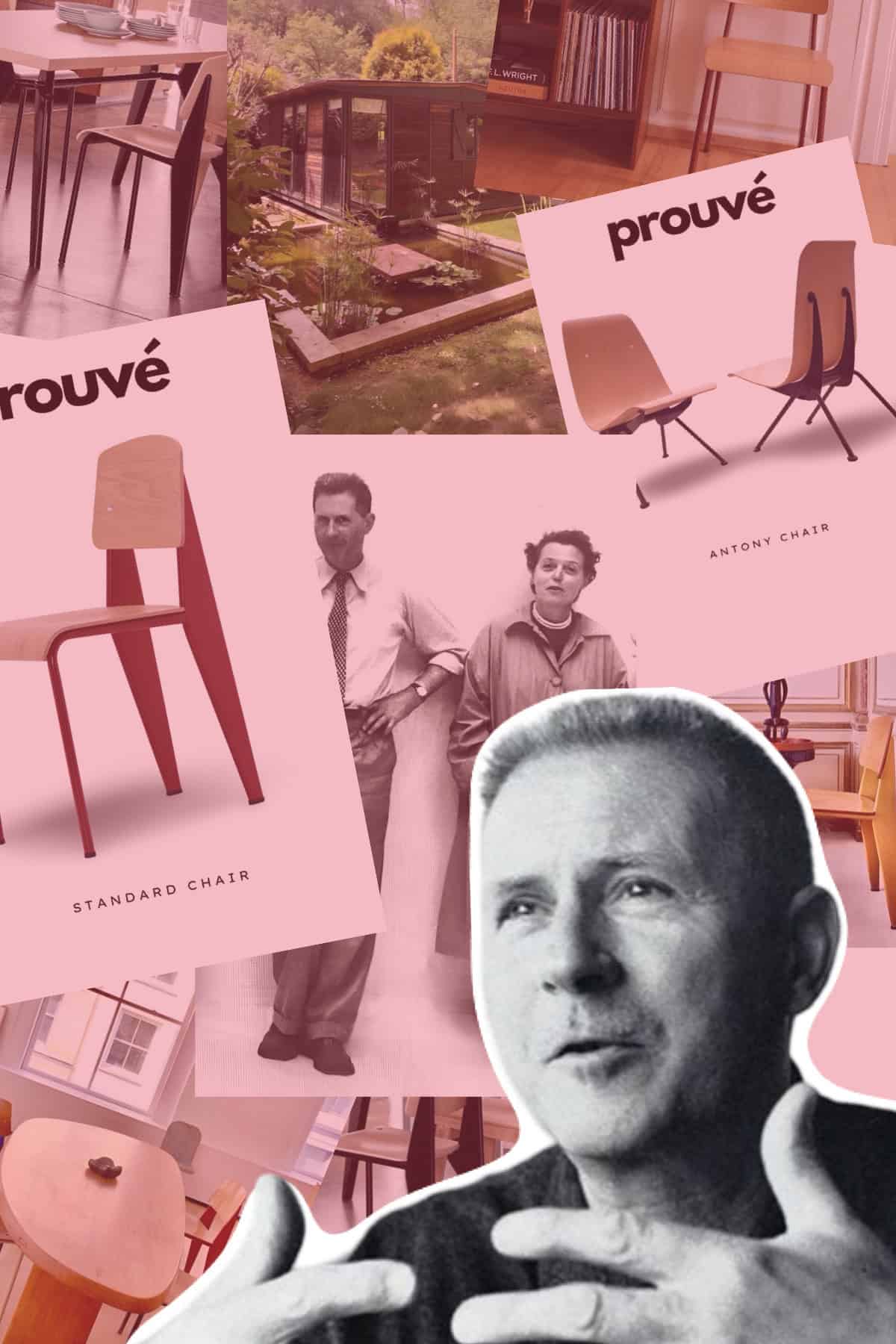
If there’s one piece that screams Jean Prouvé, it’s the Standard Chair. Designed in 1934, it’s all about that mix of steel and wood, making it a perfect blend of sturdy and stylish.

Compas Table
The Compas Table has thin, angled legs that resemble a compass, hence the name. Lightweight, minimalist, and perfect for a kitchen or workspace.

Potence Lamp
A pivoting wall light that’s as minimalist as it gets. It’s become a cult favorite for its flexibility and sleek look.

EM Table
Designed in the 1950s, this table is known for its industrial steel frame and smooth wooden tabletop. It’s still being produced by Vitra today.

Antony Chair
The Antony Chair blends comfort with innovation using a curved plywood seat and tubular steel base. It’s perfect for a reading nook or as a statement piece.

Jean Prouvé & Charlotte Perriand: A Design Power Couple
Okay, let’s talk collaborations—because when Jean Prouvé teamed up with Charlotte Perriand, they didn’t just create furniture; they practically redefined how we think about modern interiors. These two were like the dream team of design, blending Prouvé’s engineering genius with Perriand’s flair for warmth and style.
One of their standout projects was the Air France office in Brazzaville, where they combined their talents to design functional yet inviting spaces. Prouvé brought his expertise in structural elements and modular design, while Perriand added that cozy, human touch that made the spaces not just efficient but also incredibly welcoming. Together, they created furniture and interiors that were as practical as they were beautiful—proving that good design is always a perfect balance between form and function.

Their collaboration gave birth to some of the most timeless pieces out there, like the Standard Chair and Compas Table. These weren’t just furniture; they were solutions—designed to fit seamlessly into any space while also looking chic and effortless.
Incorporating Jean Prouvé’s Designs in Modern Interiors
Jean Prouvé’s furniture and architectural elements have a way of effortlessly elevating interiors with their timeless appeal. Whether you’re drawn to his iconic chairs, sleek tables, or unique lighting solutions, there’s a versatility in his work that can fit into any modern or retro-inspired space.
Below, we’ll showcase inspiring examples of how to incorporate Prouvé’s pieces into your living spaces—think dining rooms, cozy corners, or even bathrooms that need a little extra flair.


Key Milestones: How Jean Prouvé Revolutionized Design
Now, let’s talk about some of the major turning points in Jean Prouvé’s career. This guy wasn’t simply playing around with furniture design—he was out there changing the game.
- 1901: Jean Prouvé is born in Paris, surrounded by an artistic family. His father, Victor Prouvé, is a prominent member of the Art Nouveau movement.
- 1924: Opens his first metal workshop in Nancy, where he begins experimenting with metal as a material for furniture. Marries Madeleine Schott, one of his father’s students at the fine arts school. They will have five children.
- 1931: Collaborates with architect Pierre Jeanneret on designing prefabricated military barracks, showcasing his innovative approach to architecture.
- 1939: Jean Prouvé collaborated with architect Pierre Jeanneret on the design of a military barrack that could be prefabricated, shipped, and assembled in a matter of hours. This project showcased his innovative approach to prefabricated architecture.
- 1947: Establishes the Ateliers Jean Prouve in Nancy, which becomes the epicenter of his work on prefabricated buildings.
- 1952: Prouvé worked with Charlotte Perriand on the design and furnishing of the Air France office in Brazzaville, Republic of the Congo. This collaboration resulted in the creation of the “Brazza” cabinet, a prototype that Perriand later installed in her Paris apartment.
- 1954: Designs the Antony Chair, blending plywood and steel in a way that would become iconic.
- 1968: He was appointed chairman of the jury for the design competition of the Centre Pompidou in Paris. His leadership and vision were instrumental in selecting the groundbreaking design by Renzo Piano and Richard Rogers, which has since become an iconic landmark in modern architecture.
- 1984: Jean Prouvé passes away in Nancy, leaving behind a legacy that continues to inspire designers worldwide.
Conclusion: Bringing It All Together
So, let’s wrap this up. Jean Prouvé wasn’t just a furniture designer; he was a visionary who brought practicality, elegance, and that effortless cool factor into everything he touched. Whether it’s his iconic chairs that still make appearances in the trendiest interiors or his game-changing work in prefabricated architecture, Prouvé’s influence is still everywhere you look.
What’s amazing about Prouvé is that his pieces don’t just sit there looking pretty (though they do that, too). They’re built to last, to be lived in, and to elevate any space you put them in. And let’s be real: isn’t that what we all want? Beautiful things that actually work for our lives.